
Carbon accounting is commonly used by businesses, governments, and organizations as part of their sustainability and environmental management efforts. Carbon accounting is the process of measuring and tracking the amount of greenhouse gas emissions, particularly carbon dioxide (CO2) and other carbon compounds, that are released into the atmosphere as a result of human activities. It involves the calculation of an organization's total greenhouse gas (GHG) emissions, encompassing both direct and indirect sources. Analogous to financial accounting, carbon accounting assesses the impact of organizational operations, but its primary lens is on climate impact rather than financial effects.
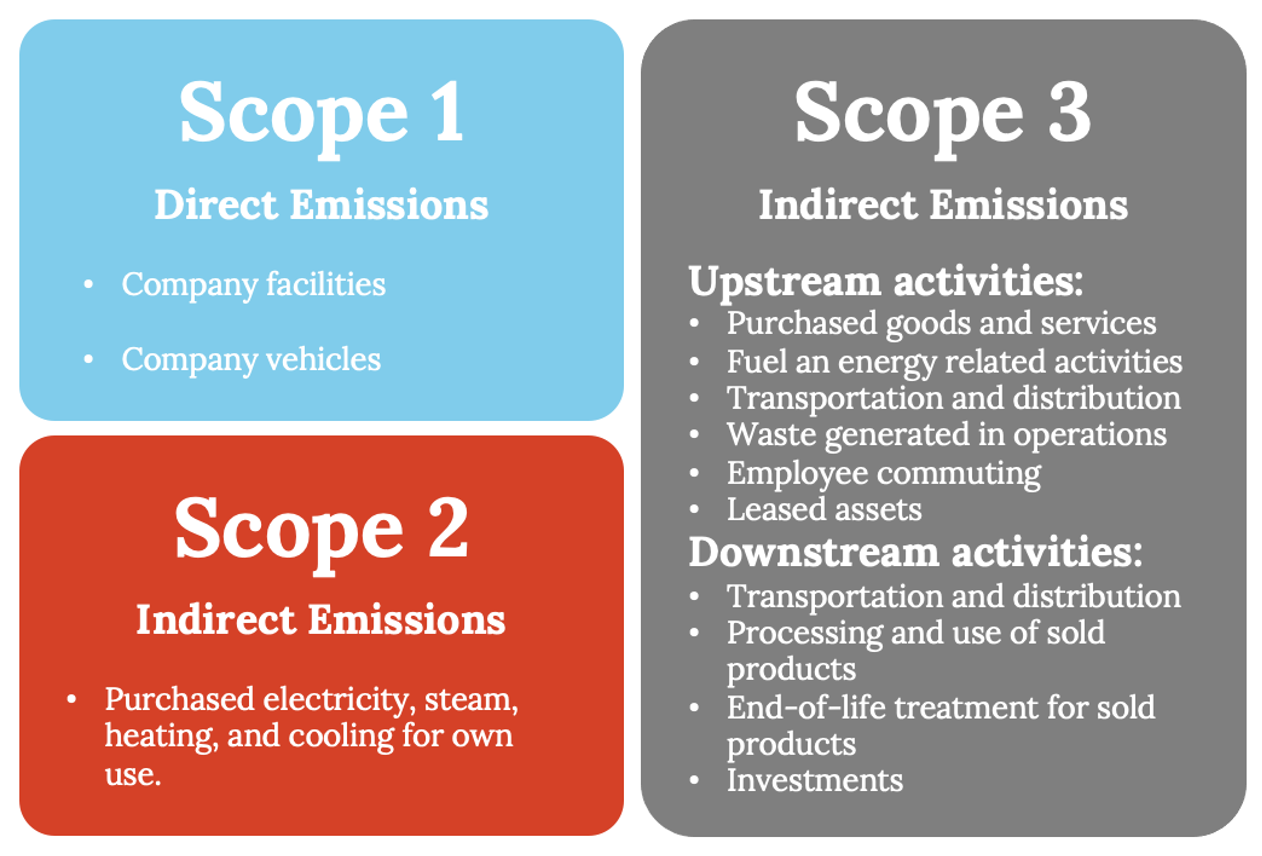
The Greenhouse Gas Protocol, formulated by the World Resources Institute and the World Business Council for Sustainable Development, categorizes a specific company's emissions into three classifications known as "scopes":
Scope 1, or "direct" emissions, encompasses all emissions directly produced as a result of the company's operations.
Scope 2 denotes "indirect" emissions arising from the consumption of purchased electricity, steam, heating, and cooling used in the company's operations.
Scope 3, often labeled as supply chain emissions, comprises indirect greenhouse gas emissions linked to a company's activities but originating from sources beyond its ownership or control.
Carbon accounting requires two key components: data collection and data processing. For businesses to proficiently manage their emissions, it is crucial to guarantee the thoroughness of data collection and the reliability of the data processing methodology. The accuracy of this assessment relies on the comprehensiveness of the calculated emission sources, the quality of spend and activity data inputs, and the accuracy of the employed emissions factors.
Why is Carbon Accounting Important?
Empowering Net Zero Emissions: Systematically measuring and tracking the carbon footprint enables organizations to set realistic reduction targets and implement strategies to offset or mitigate remaining emissions.
Understanding Environmental Impact: Carbon accounting offers a structured framework for organizations to comprehensively understand and quantify their environmental impact, going beyond compliance to gain insights into significant contributors to their carbon footprint.
Improving Decision-Making: Data generated through carbon accounting empowers informed decision-making, helping identify areas for operational changes or investments in sustainable practices that yield significant environmental benefits.
Challenges of Carbon Accounting:
Lack of Standardization - One of the primary challenges in carbon accounting is the lack of standardized methodologies and reporting frameworks. Different industries and regions may use varied protocols, making it challenging to compare and benchmark emissions data across organizations. Establishing universally accepted standards for carbon accounting would enhance consistency, transparency, and the reliability of reported data.
Data Collection Accuracy - The accuracy of carbon accounting heavily relies on the precision of data collected. Gathering comprehensive and precise information about direct and indirect emissions, as well as related factors like energy consumption and supply chain activities, can be challenging. Inaccuracies in data collection may lead to skewed emissions estimates, hindering the effectiveness of emission reduction strategies and compromising the reliability of reported results.
Resource Constraints - Carbon accounting requires a significant investment of time, resources, and finances. Collecting, processing, and verifying data, especially for comprehensive emission assessments, can be a time-consuming task. Many organizations, particularly smaller ones or those with limited resources, may face challenges in dedicating the necessary personnel and financial resources to implement robust carbon accounting practices. This can impede the frequency and depth of carbon reporting efforts.
Benefits of Carbon Accounting:
Stimulating Sustainability - The process of carbon accounting often stimulates innovation as organizations seek novel and sustainable approaches to reduce emissions. This can lead to the adoption of new technologies, processes, and business models that not only benefit the environment but also enhance competitiveness by focusing on sustainability.
Promoting Accountability and Transparency - Carbon accounting promotes accountability and transparency by providing a clear picture of an organization's environmental performance. This information builds trust among stakeholders, including customers, investors, and the public, who are increasingly concerned about the environmental practices of the entities they engage with.
Optimizing Resource Efficiency - Through the process of carbon accounting, businesses can identify inefficiencies in resource use and energy consumption. This insight enables them to implement measures that improve resource efficiency, reduce waste, and lower operational costs. As a result, organizations can simultaneously enhance their environmental performance and achieve financial savings.
In general, carbon accounting serves as a crucial instrument for businesses aiming to diminish their carbon footprint. Beyond contributing to the fight against climate change, this practice also enhances a business's ability to appeal to customers, investors, and employees.
References:
Farbstein, E., Vallinder, A., & Buchmann, L. (2023, October 26). Carbon Accounting, explained. Normative. https://normative.io/insight/carbon-accounting-explained/#:~:text=seize%20business%20opportunities.-,What%20is%20carbon%20accounting%3F,impact%2C%20it%20tracks%20climate%20impact.
Pittard, C. (2022, December 28). 5 carbon accounting challenges and how address them. WatchWire. https://watchwire.ai/5-carbon-accounting-challenges-and-how-address-them/
Rousselot, S. (2023, June 22). Carbon accounting: What it is and 5 benefits for businesses. Tapio. https://www.tapio.eco/blog/what-is-carbon-accounting-and-what-benefits-can-it-bring/
Webber, M. R. (2023, October 11). What is Carbon Accounting?. Investopedia. https://www.investopedia.com/carbon-accounting-7562229